
OPERATION BLACKBERRY
Index | Page 1 | Page 2 | Page 3 | Page 4 | Page 5 | Page 6 | Page 7
REALLY RATHER SECRET
Senior Naval, Marine and Scientific personnel, Wood's Asteroid temporary base.
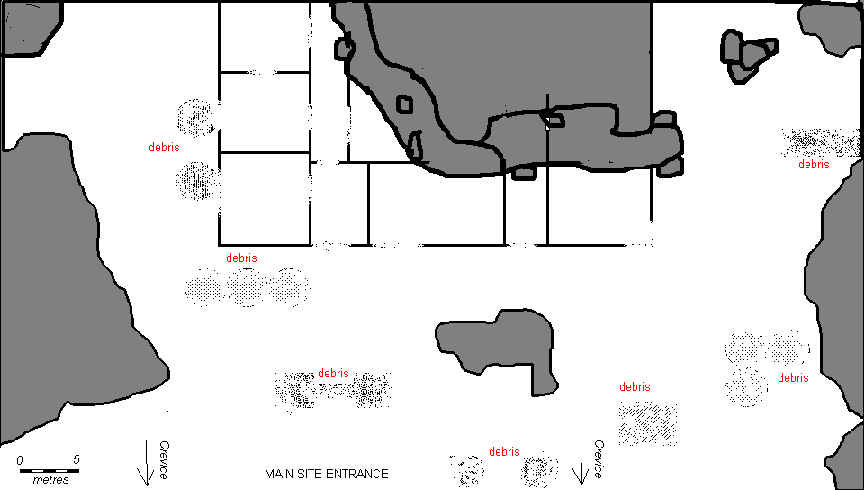
The site was revealed during routine work on abandoned Belter space habitats in the Tuskan system. The initial site survey was conducted by Jacob Connell BSc. His site plans can be found at Appendix A. The structures revealed on the detailed site drawing were typical of Forerunner remains encountered at CLASSIFIED. In addition, the detectible presence of power emanations from the asteroid were suggestive of a still partially functioning Forerunner site.
Accordingly, arrangements were made to secure the site as quickly as possible, and, after surveying and recovery of surface artifacts were complete, to penetrate to deeper levels of the asteroid as soon as practicable.
Please refer to the cross-sectional site plan. The main (vertical) crevice has two horizontal sub-creivices, which were dubbed 'Rome' (the one containing the Forerunner site) and 'Carthage' (the one opposite). A preliminary camp was constructed in Rome crevice for storage of machinery and handling of finds. A Marine encampment was set up in Carthage crevice.
Initial work revealed extansive remains of Forerunner artifacts in the site debris, which were removed for later cataloguing. Geophysical surveying of the area revealed a large open expanse about 10m below the initial site, with three shafts leading to the surface. Rubble was cleared to reveal three 'hatches', labelled A, B and C. Hatch C and its (broken) mechanism was removed with its rock surround to preserve integrity for later examination. An entry hole was bored parallel to shaft C, which opened into the first sub-level. Entry to the subterranean complex was achieved at this point.
The initial penetration was made by a combat robot under the direct control of Major Howland. Its (regrettably meagre) sensor equipment revealed an item of Forerunner machinery in an underground room. The Marine contingent became notably more tense at this discovery, as the item was judged to be similar to previously encountered 'exterminator' equipment (see 130th Regt scientific survey results). This particular item had been dubbed a 'Clanker' by the Marines.
However, the unit appeared to be powered down, and once human personnel had made an entry into the area, the artifact was coded Forerunner Artifact (Mobile) - FAM # 1 and removed for later study.
At the insistence of Major Howland, subsequent investigations of the subterranean complex were performed by a Marine detachment assisted by myself and Mr Connell.
The complex proved to be very extensive, consisting of seventeen main zones (including the initial site), linked by interconnecting tunnels.
The overall three-dimensional site plan is given at Appendix B. In spite of concerns by the Marine team, exploration proceeded swiftly and smoothly.
The long vertical tunnel on the plan contains what are apparently power conduits, as well as being an alternate (emergency?) route to/from the surface of the asteroid.
The site has yielded so great a storehouse of Forerunner items and equipment that it is difficult to know where to begin. As well as the original 'robot' (FAM 1), three more mobile artifacts of similar but different design were also extracted from Zone 12 (FAM 2,3,4) for later study. Zone 17 contained another three, but these were still under motive power, and will be detailed separately (section 7).
Zones 6, 8, 11 and 14 contained tanks with approximately man-sized depressions which have tentatively been identified as relating to habitation. Fuller investigation of these devices is required.
Zone 13 contained sealed areas, cages which seem to have contained organic material, and apparently scientific equipment, and has been identified as a biochemical research facility of some kind. No penetration has yet been made into the sealed areas.
Zone 14 contained large tanks with evidence of organic material and water, tentatively identified as hydroponic tanks.
Zone 9 contained control equipment.
Zone 10 contained the power source - several large fusion reactors.
Two were still in working order, two were rusted and otherwise non functional. The Naval technicians estimate that each power plant is capable of putting out power equivalent to the total of a fleet's power output.
Zone 8 contained three rooms with an intriguing device - see section 6.
Zones 3, 5, 6, 12 and 16 contained more as yet unidentified machinery.
Finally, Zone 17 contained the most startling find of the expedition: an apparently fully functional Forerunner artificial intelligence! (see section 7)
Glyphs of the sort found at CLASSIFIED were in great abundance throughout
the complex. Fortunately, from work already performed, and with the huge
profusion of glyphs found here, a final full translation of the Forerunner
written language was able to be achieved in only a few days. An honourable
mention must be made here of Major Patel's identification of one of the rooms
as a stores area - decoding of the
 door glyph as 'Stores' proved to be the 'Rosetta Stone' for
the alphabet. A great deal of pioneering work on translation was also achieved
by the tireless work of my research assistant, Jerry. As a result, were were
able to read titles of various areas, including warnings about radiation
(in the power level) and biohazards (in the lab section) - the reason why
the sealed areas remain sealed. We have also been able to establish which
are communication and habitation areas.
The key to language translation occurred at a very fortuitous moment, as
the Marine team, led by Mr Connell, had just penetrated into
an area of apparently man-made but 250 year old tunnels. In fact, these proved
to be illusory, and the whole area was labelled 'Holo Room'.
This area, in Zone 8, appeared to contain three holographic training suites, similar to the VR units used by the Marines. However, their mode of action was very odd. We can only deduce from experiments using combat robots as well as humans that the machine is able to alter human perceptions of their surroundings at a neural level. It also seems to respond in some way to expectations (in Mr Connell's case that of old human space structures - the subject of his doctoral research) and is able to construct a reality from people's memories.
Unsurprisingly we have been very wary of exploring this very powerful device.
Access to a sealed area of Zone 17 was achieved by Marines using cutting equipment. Inside were three of the 'robots' of similar type to that encountered earlier. However, they quickly moved to repair the breach, and when the Marines physically prevented them from doing so, a voice on our comm channel identifying itself as 'Majordomo' asked us to desist, and to withdraw from the control area.
We complied with its request, and subsequent communication revealed that this seems to be a Forerunner artificial intelligence which was originally responsible for upkeep of the base. It warned us that the base was in vacuum, and that we should withdraw for out own safety, although it was mollified when told we wore self-contained environment suits which removed this problem. It was the discovery of Majordomo which prompted us to withdraw from the complex to rethink our next move.
Finally, some of the machinery in Zone 16 has been labelled by glyphs which translate as 'Macrospace Transmat'. The precise meaning of this is unclear, but seems to indicate that some Matter on a Macro level is being Transported through Space. This may be the reason for the huge power supply for the complex. But what is being transported, and where to?
It may be that this device is capable of physically moving the entire complex through space, or perhaps hyperspace. However, there is a 'booth' in the Zone capable of holding several people, and it may be operating on a much smaller level.
Little investigation has yet been performed here.
9.1 The site has surpassed every expectation in terms of its guide to Forerunner culture. No skeletal or fossilised remains of Forerunners have been found, implying that the site was deliberately abandoned.
The reason for this is still unclear.
9.2 Most intriguing (and for the Marines, disturbing) is the apparent connection between the Forerunner machinery and the exterminators. It seems that the hypothesis that the exterminators were originally creations of the Forerunners may be correct, and this site may prove to be the key to understanding the menace that now faces us.
9.3 The explored area of the complex (some passages are still blocked by rubble) look to have originally supported 100 or so Forerunners.
The power supply is in huge excess for a human installation of such a size, and so far of the discovered machinery only the mysterious 'Macrospace Transmat' would seem to require such a level of power input.
9.4 The general level of technology revealed is far in excess of human capabilities. It is possible that close examination of this site could bring about quantum leaps in human technology.
9.5 Much of the technology seems to react only to the presence of biological life forms. However, while obviously designed originally for Forerunners, it seems to work just as well for humans, raising interesting questions about the similarities between the two species.
10.1 The 'Agamemnon' was forced to urgently withdraw to assist fleet operations during the time we were exploring the complex, and will soon be out of the Tuskan system. We thus have no means of travelling apart from two small shuttles.
10.2 This site is not only of huge scientific importance, it must also be regrettably admitted that it also raises huge security issues as well. Two groups of marines does not seem an adequate guard force under the circumstances and immediate efforts must be made to make the site more secure.
10.3 At the moment, our best hope of understanding (a) the complex, (b) the Forerunners and (c) perhaps the exterminators seems to lie in continued communication with the entity 'Majordomo'. With the greatest respect to our combined capabilites, we seem to be in a 'First Contact' situation, and I wonder how well equipped we are for it.

Small statue found in rubble in Wood's asteroid site. |
While we have enough finds for several years' further study, I would
submit that priority at the moment must be continued communication with
Majordomo, to access the wealth of knowledge that must be at its fingertips.
I am willing to attempt to continue this dialogue, but I would be more reassured
if I had greater scientific expertise in other areas available to me. However,
given the importance of this site, and the inevitable attraction it might
have for other groups (pirates, perhaps other nations, even the Tuskan
authorities), I am not sure we can afford to wait for back-up to arrive before
proceeding with further attempts to communicate.
I would be grateful for the points of views of others on what we have found so far, and what our next move should be.
Catherine Peabody. |
Index | Page 1 | Page 2 | Page 3 | Page 4 | Page 5 | Page 6 | Page 7